

how to draw a bode plot
Rules for Amalgam Bode Diagrams
This certificate volition discuss how to really depict Bode diagrams. Information technology consists more often than not of examples.
1. Rewrite the transfer function in proper class.
A transfer office is normally of the form:

Equally discussed in the previous certificate, we would like to rewrite this so the lowest order term in the numerator and denominator are both unity.
Some examples will clarify:
Case ane

Notation that the final outcome has the lowest (zero) order ability of numerator and denominator polynomial equal to unity.
Example 2

Note that in this example, the everyman power in the numerator was 1.
Case 3
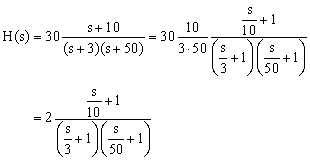
In this example the denominator was already factored. In cases like this, each factored term needs to accept unity equally the lowest gild power of s (zero in this case).
2. Separate the transfer part into its constituent parts.
The adjacent footstep is to separate upwardly the function into its elective parts. There are seven types of parts:
- A constant
- Poles at the origin
- Zeros at the origin
- Real Poles
- Real Zeros
- Complex conjugate poles
- Circuitous conjugate zeros
Nosotros can use the examples higher up to demonstrate again.
Example 1
This office has
- a constant of 6,
- a zero at south=-10,
- and complex conjugate poles at the roots of sii+3s+50.
The circuitous cohabit poles are at s=-i.5 ± j6.9 (where j=sqrt(-ane)). A more than common (and useful for our purposes) way to limited this is to employ the standard notation for a 2d order polynomial

In this case

Example 2
This office has
- a constant of iii,
- a zero at the origin,
- and complex cohabit poles at the roots of stwo+3s+fifty, in other words
Instance 3
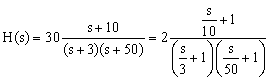
This function has
- a abiding of 2,
- a zero at s=-x, and
- poles at s=-iii and southward=-50.
3. Draw the Bode diagram for each part.
The rules for cartoon the Bode diagram for each part are summarized on a separate page. Examples of each are given later.
4. Describe the overall Bode diagram by adding upwardly the results from footstep three.
Afterward the individual terms are drawn, it is a simple affair to add together them together. See examples, below.
Examples: Draw Bode Diagrams for the following transfer functions
These examples are compiled on the next page.
Example 4
Repeated poles, a zilch at the origin, and a negative constant

Full Solution
References
Replace

Source: https://lpsa.swarthmore.edu/Bode/BodeRules.html
Posted by: uptongramemptere.blogspot.com
0 Response to "how to draw a bode plot"
Post a Comment